Out in the country, there are many beautiful sights in spring. Trees starting to bud, flowers blooming–at least my tulips are getting close to blooming.
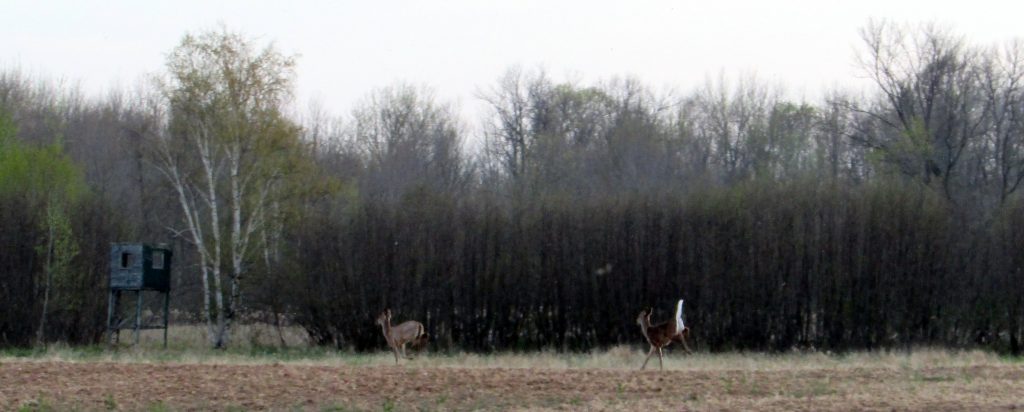
Another beautiful sight is seeing deer running across fields again. This photo shows deer kicking up their heels as they cross Sunnybook Farm.
See them run
Bob and I love watching wildlife on our farm. When we were housebound, our only view was from our windows. Deer usually don’t come close to our house. These two are far in the back 40. They are only seen from the seat of our cart, or tractor.
With binoculars, we saw some at a distance from our house. Nice to know at least some whitetail have survived our harsh winter. We now look forward to seeing new fawns as our weather warms.
Morning and night we feed our pets. Our inside cats and dog tell us what time it is. When the cats start meowing and annoying us, we know it’s time to set out fresh food. Sunny, our dog, goes along with the crowd. At meal times, he’s happy the cats annoy us.
Othello and Cruella might love one kind of cat food one day, but when I set out the same food the next day they sometimes turn their noses up at it and walk away. Of course, soon they will be begging for their meal, but this time I know that they are asking for treats, not that silly canned stuff.
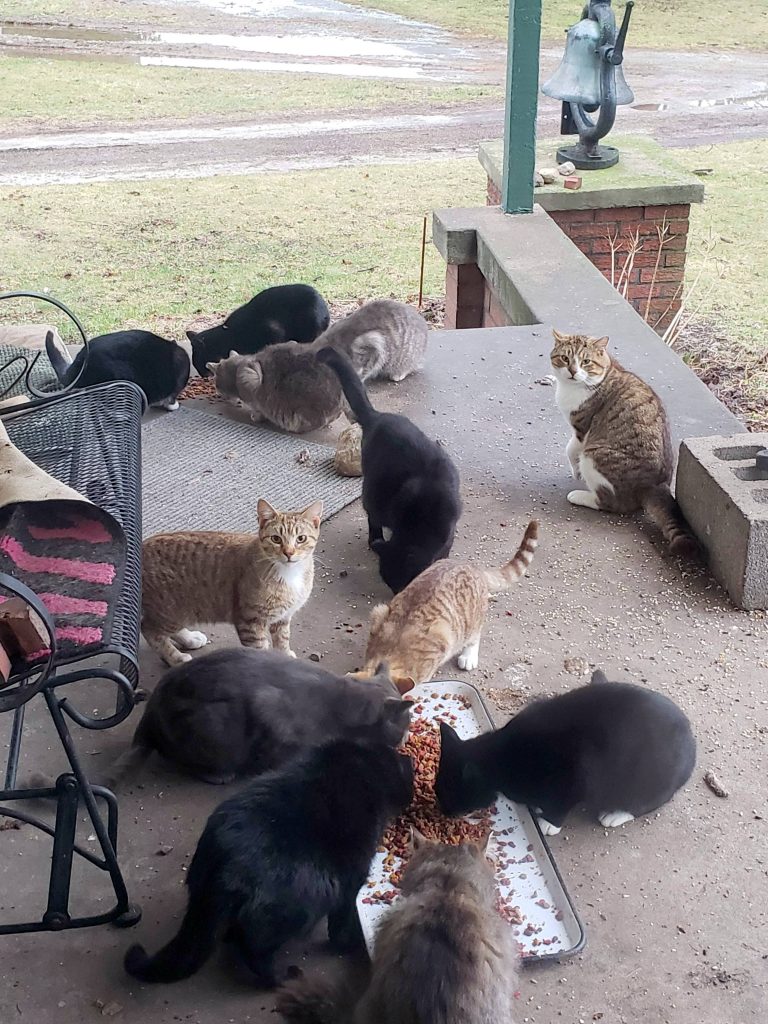
The feral barn cats are not allowed in the house, but they still manage to let us know when they are ready to eat. There’s a bench outside our kitchen window. An outside cat or two will climb up and look inside the window. This usually happens when Bob and I are eating.
The peeper gives a pathetic look like it will starve if food doesn’t arrive soon. I then gather up their bucket, put in their kibble and save them from starvation.
These 12 barn cats are happily starving…not.
Last night I added the drippings from our roast. The cats gorged themselves. Since there was plenty to go around, no grumbling took place. After eating I was sure I heard them groan because they had eaten too much–they are so deprived.
Sunny is family. It doesn’t matter that he has four legs and fur. This dog is definitely part of our family. He even looks a little like us.
Taking a walk with Sunny is good for the dog and good for me. I read somewhere that people are healthier when they have pets, especially a dog. I’m sure this is true. A dog never judges you. It just loves you even if you are having a bad day.
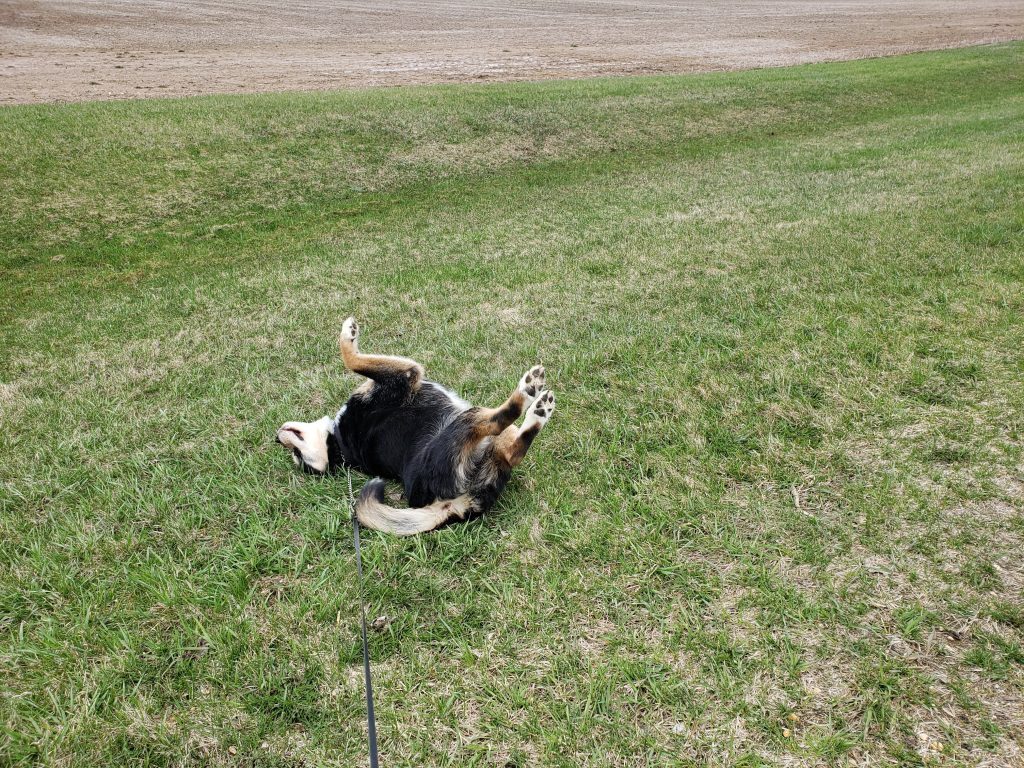
Sunny likes to start our walks by rolling in the ditch. I just hope that this time he hasn’t found something nasty to roll in.
We’ve had Sunny for nine years. He’s not only my walking companion, he’s also Bob’s pal, too.
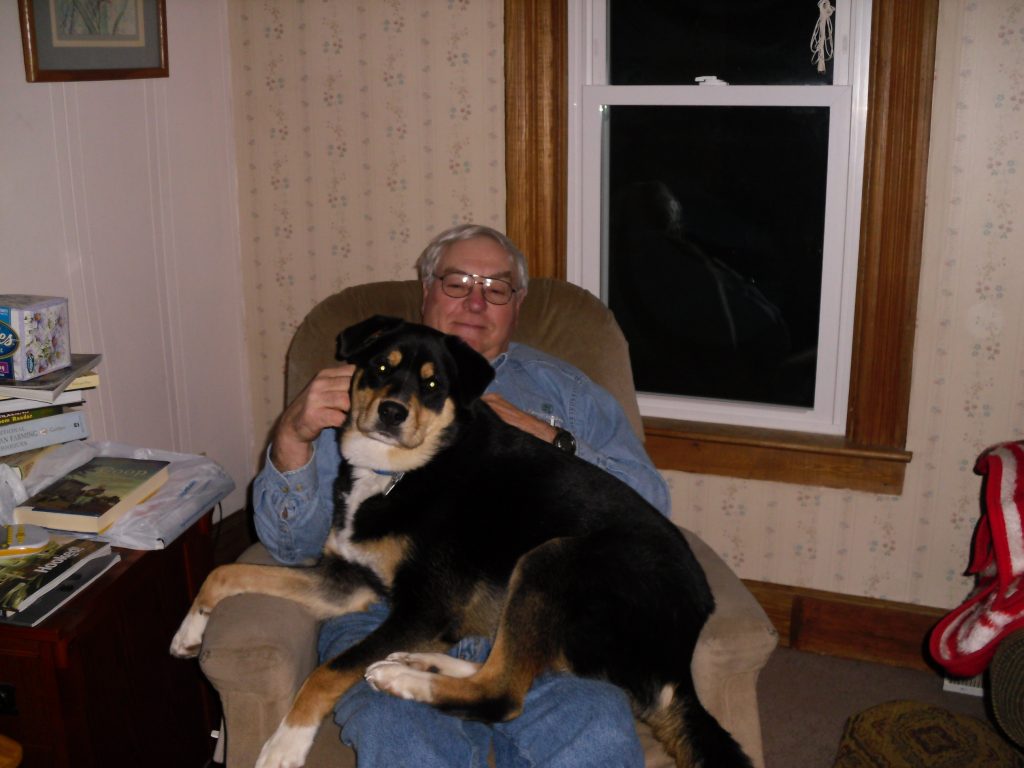
One day–quite a while ago–Sunny thought he was a lapdog. He didn’t like the cats having the best seat in the house.
Today we took Sunny for a ride in our cart. It’s one of his favorite activities. As we drive he gets to look for wildlife. Too bad no birds or beasts showed up this time, not even a barn cat. Instead, as Bob drove, I went along the roadside ditch and picked up garbage. We all benefited from being out on a lovely Saturday afternoon and the countryside looks a whole lot neater.
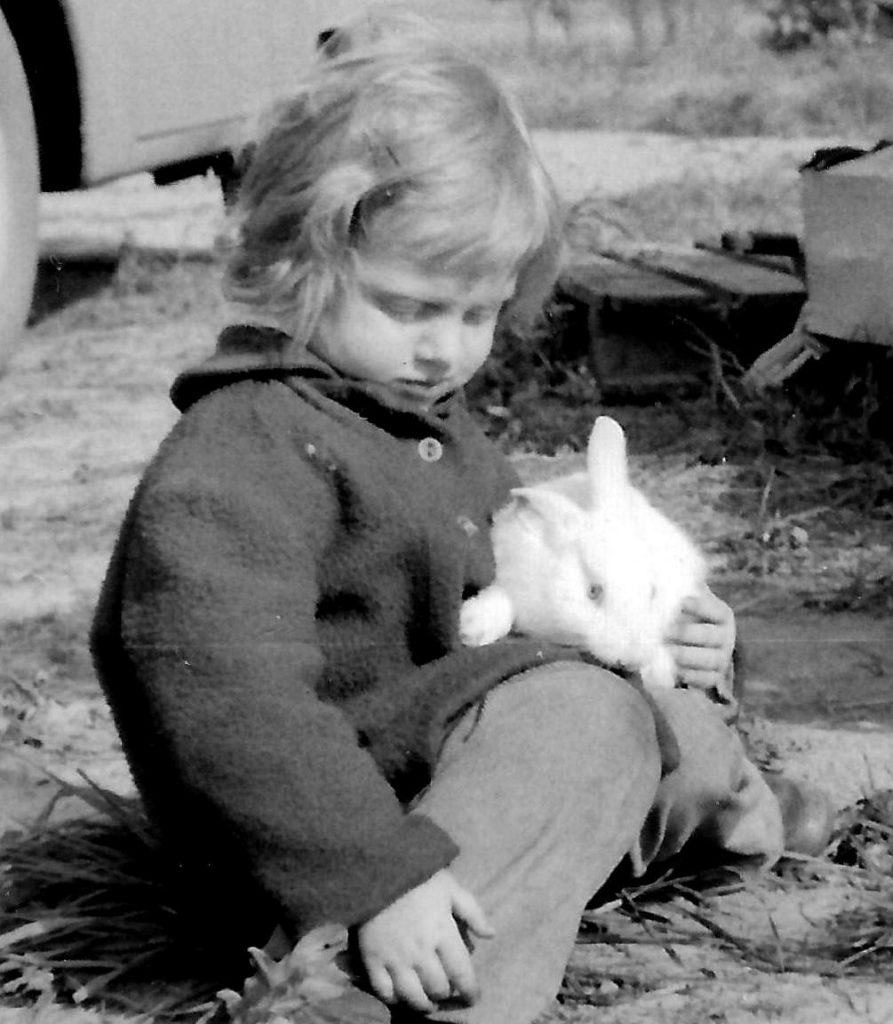
My dad chose my name, Susan. My parents called me Suzie-Q when I was little. As I grew, they called me Susan. I don’t know where the name came from. Dad just said he liked it and never had a boy’s name in mind. Of course, back in 1950, there was no way of knowing what their little baby would be before birth. Good thing I wasn’t a boy or I might have been a boy named Susan.
My sister came along 18 months later. When Karen started to talk she couldn’t say Suzie. Ss were hard for her to pronounce. Karen shortened my name to Z. Just thinking about my little sister following me around and calling me Z gives me a warm feeling.
Back in 2007, my Bob had trouble with his Allis-Chalmers D-15 tractor. He was using the tractor and loader, moving tree branches he had cut when suddenly the engine made a horrible sound. Somehow Bob was able to limp back up the lane to the machine shed before the poor old tractor went belly-up.
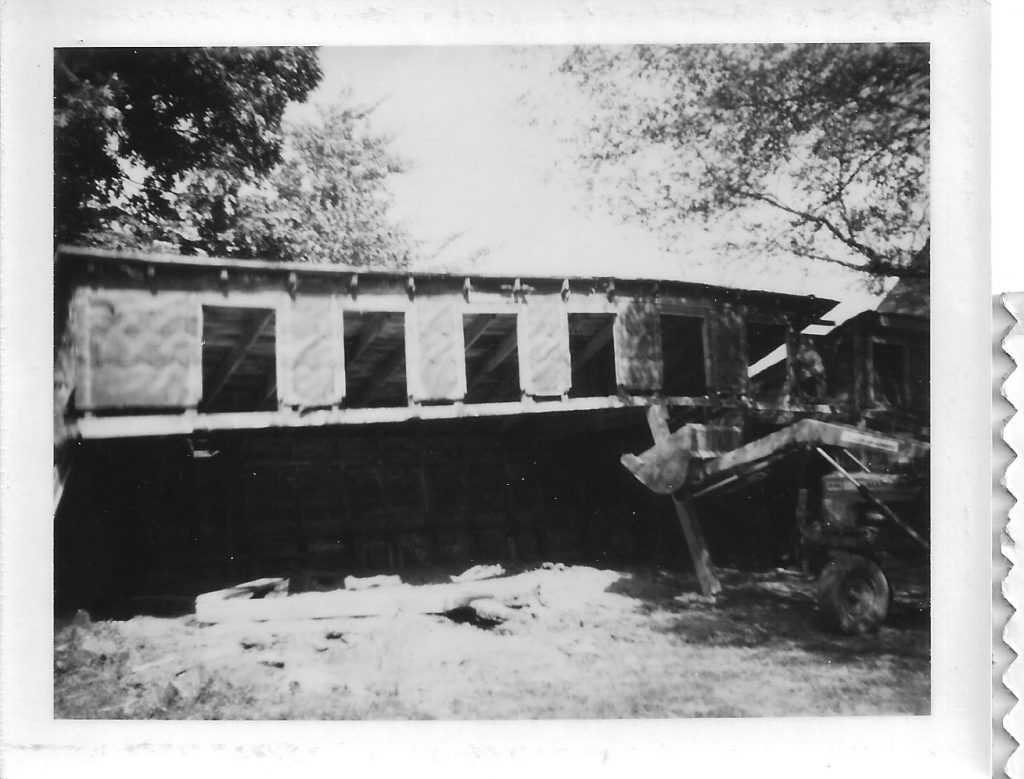
The D-15 took down the old chicken house in the late 1960s.
Bob knew right from the start that he had major problems. He didn’t have a lot of hope for it even when he started to take the engine apart. Deep inside the innards of the tractor, Bob found the starter had disintegrated, sending pieces of metal into the engine, wrecking it.
“What are we going to do now?” he said to the tractor. He had a couple of choices: try to rebuild that engine (parts would cost more than the tractor was worth), junk it and buy a replacement (if he could find one) or take the engine out of his other D-15 and make one out of two. He decided on the last choice and began dismantling the broken tractor, but first, he had to remove the loader.
The loader on the AC D-15 isn’t like new models that attach and detach with a quick click. There’s a lot more to it. While I was helping Bob take out pins and bolts, he started telling me about his first tractor with a loader.
“It was a John Deere A,” said Bob. “Up until then, we used pitchforks to clean out the barn and fill the manure spreader. This loader on the D-15 is modern compared to that A.
“First off the John Deere A had a
narrow front end. It also had a hydraulic pump that worked off the Power-Take-Off
(PTO). The only time you had power to the hydraulic pump was when the PTO was
running. The thing with this tractor was the PTO stopped every time you
disengaged the clutch.
“Let’s see if I can explain it to
you,” he said to me. “You had to shift the tractor into neutral and engage the
clutch to raise the loader. With that narrow front end every time you hit a
hole you’d get stuck, especially when you had the loader full and since the
loader only had a hydraulic lift you couldn’t use to get yourself unstuck.” (You should know that Bob is a pro at using
the D-15 loader to push down into the ground to get out of trouble.)
“To dump
the bucket, you’d pulled a lever that would trip it. There was no hydraulic on
the bucket. If you were lucky, the spring would bring the bucket back into
place. Otherwise, you’d have to lower it to the ground, back up, scraping it
against the soil so it would latch back in place.
“Here’s how it went,” he said. “Every time you loaded the bucket, you would drive forward into the pile, disengage the clutch, shift into neutral, engage the clutch so the hydraulics would work, raise the loader up, disengage the clutch, shift into reverse, engage clutch to back up, disengage the clutch, put it in forward gear and engage the clutch to drive forward. You could raise the loader while you were moving, so if you planned ahead you would have it at the right height when you got to the manure spreader.
“If you screwed up, which I did a lot at the beginning, and needed the loader up some more to dump the bucket you had to stop, shift into neutral, engage the clutch, raise it up, disengage the clutch, shift into gear, move forward and then dump. But it still saved a lot of work. It was a heck of a lot better than using a pitchfork that’s for sure.
“This orange baby is an environmentally green machine now,” Bob said with a smile as he started it after making one running tractor out of two. “The only thing new on it is the oil filter. Even the tires are off an old combine.” (My husband is big into reusing what he has at hand.)
The D-15 was used when Bob and his
father bought it in 1967. As Bob wiped the grease and oil from his hands he
said, “I wonder if there are other farmers out there who keep an old tractor
around just for old time sake? I kind of think there are.”
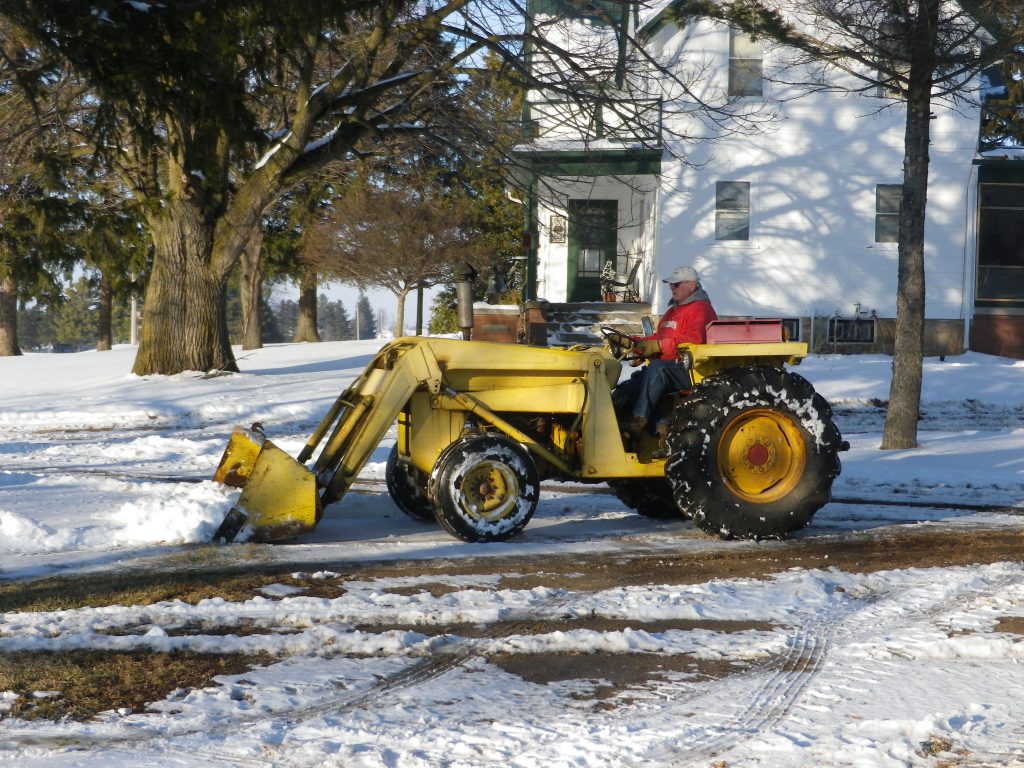
This photo from 2013 shows Bob driving his MF 2135 tractor. It replaced the D-15
I too think there are farmers who have a love affair with their old tractors. If you’re one of them, drop Bob a line and tell him about the old machine you love or one you fondly remember. He’d like hearing from you.